|
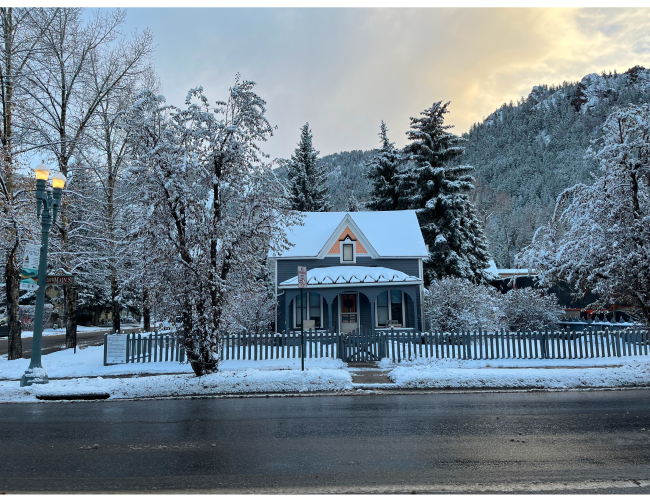
Amid so many recent changes, every so often a specific change to Aspen hits particularly hard. For me, it was the recent discovery of the little Victorian at 205 W. Main, wrapped in plastic for asbestos abatement. This signaled what I had long dreaded and fought to prevent: plans by the Mollie hotel owners to redevelop this historic structure on its prominent corner lot into a dense, multi-building subsidized housing complex. I found myself absolutely gutted.
But it’s more than that. “205” is the perfect, albeit sad, metaphor for Aspen and what we’ve become. It has long been our rich and storied history, and our priority to protect it, that buoyed us and knit us together as an historic small town community. But today, that history and what it represents is merely “old,” and only nominally in the way of more current pursuits and priorities, namely building housing for anyone and everyone who wants to live in Aspen affordably.
You’ve driven past “205” daily for as long as you’ve been in Aspen. She’s no Sardy House nor Floradora Building, but rather a little 1890s-era gray and white Victorian, set back on a corner lot on the southwest corner of 1st and Main, featuring a charming front porch with a matching picket fence and a notable gable accented in yellow.
The plans for 205 W. Main are nothing short of astonishing: an 8000 sf 3-building complex featuring ten 2- and 3-bedroom units (approximately 22 bedrooms, which could feasibly house 44 people) on the 7500 sf lot. Only ten alley parking spaces are planned in this dense, already under-parked neighborhood.
As I reminded in Issue #234 that outlines the history of this project, the AACP states, “A respectfully restored historic structure or site honors the history and culture of our town, whereas a demolished one erases a piece of the Aspen story forever.” I fear this is our new normal.
How could this happen? Isn’t she historic? Good question. Yes, in fact the house is from 1890 and is indeed a local historic resource. But in today’s Aspen, that only kinda matters. “Historic designation” is now completely meaningless if what’s being bastardized will become “housing.” In that case, all bets are off, and this includes HPC’s ability to deny applications; they can only review for design and historic guideline compliance, which, with “205” as an example, allows for relocation on its own lot and removal of questionably non-historic additions. Other variations from standard zoning such as drastically compressing the historic house into a corner of the lot to accommodate the new construction, reduced setbacks and increased lot coverage were allowed because the property would now be used 100% for housing. You see, in 2022, council changed the local land use code to allow subsidized housing in all zone districts.
Buckle up - those chickens are just now coming home to roost.
As expected, there was significant pushback from the neighbors, primarily about parking and density, as well as concerted objections from several on HPC. Sincere appreciation to longtime locals Roger Moyer, Barb Pitchford and Jody Surfas whose valuable knowledge and tireless advocacy for HPC’s own mission of protecting and preserving those properties which represent the distinctive elements of Aspen’s cultural and architectural history was steadfast and supportive. They made the strong case for “saving” 205 W. Main over months of deliberation.
But in the end, it was the land use code, not common sense, not historic preservation, not any level of appropriateness, that superseded everything else, forcing HPC’s tightly tied hands to ultimately approve the application, despite knowing full well what this now means for the historic asset. That, and the trend toward appointing newcomer architects and realtors to the volunteer board whose personal preferences for “more housing anywhere and everywhere” over the preservation of Aspen’s historic treasures translates into what’s become a shocking new cultural indifference. (A former HPC member told me, “I did not look at it as losing an historic asset. I looked at it as bringing it back to local living.”) Council never even had a say in the matter. The land use code is so clear it never rose to that level.
Considerations such as “density,” “neighborhood character,” and “appropriateness” used to carry weight, especially pertaining to historic assets in the designated historic district. Today, everything is fair game for sacrifice at the altar of “housing.” I don’t have to remind you that there is no verifiable count of how much housing we have, we don’t know who’s in it or where they work, and there is no goal for when we have reached enough. Yet with our “favorable” new land use code, and the emerging paradigm whereby employers who can afford to are buying/building their own housing to control their own employment destinies, look for A LOT more like this to come.
In fact, the hospital has just received approval for the radical redevelopment of its proprietary housing complex, The Beaumont, a former ski lodge on East Cooper as you head out of town toward Independence Pass. This 25-unit complex is now slated to be redeveloped into 60 mostly 1-bedroom units across seven new buildings. Neighbors petitioned the usual bodies and made compelling public comment, primarily about the massive new density, traffic generation and on-site parking, to no avail. When you have housing-at-all-costs zealots on council (“I think that density is a housing solution, I think it’s an environmental solution, and this seems like an appropriate place to increase density. It’s on the highway, it’s walkable to town, it’s within a couple miles of their employer,” said Christine Benedetti), rational requests for even a slight reduction in density from Bill Guth and Sam Rose didn’t stand a chance. Besides, it was a foregone conclusion. As a political subdivision with its own taxing authority, the hospital has full authority over what falls within its jurisdiction, including the use of its own land. Even if council had denied the project, the hospital's board could just over-ride it and grant itself approval.
Look for even more "housing” at the Aspen Meadows campus, where council (minus Bill Guth) just greenlit 54 new housing units for the Aspen Institute, Aspen Music Festival and School and the Aspen Center for Physics. Designed for employees and visiting physicists (think proprietary short-term rentals), this multi-faceted project is sure to dramatically compound the already untenable West End traffic issues, especially along 4th Street. But in the name of “housing,” these traffic issues are merely to be “further studied.” Councilman Sam Rose summed it up best, stating the traffic issues “are city issues, not applicant issues,” missing the glaring fact that they’re still big issues that aren’t going to resolve themselves!
That’s 22+60+54=136 “more” housing units from just the aforementioned projects. How many bedrooms do these 136 units represent? How many employees will live in each bedroom? Which local jobs will these employees fill? Does this move the needle? Who is keeping track of the metrics? What tally do these get added to? (Owned by the individual entities, none are “APCHA.”) Where does this end?
Meanwhile, if you own a historic property not unlike “205” in the historic district, good luck trying to replace your drafty windows. And god forbid you need a new roof because your insurer won’t cover your house with those old cedar shake shingles. The process is an arduous, mind-numbing and costly affair. There are plenty of examples of homeowners stuck in development limbo, despite there being a rumor that there is one specific roofing product the city might just entertain. Might. (You rich, private property-owning fool, this isn’t about you! No one cares about you and your second home. Just shut up and pay your taxes. We’re busy building housing here.) I used to jokingly make Dr. Zhivago parallels, but I’m not laughing anymore.
Hypocrisy? Of course. Housing at any cost. Subsidized housing is specifically exempt from growth limits, and in our otherwise staunch “no growth” community, surprisingly no one will acknowledge the very real and increasing 24/7/365 community impacts of housing growth, as if there aren’t any. They clearly think we’re that stupid. In reality, those carrying the weight (and being targeted for draconian regulations and controls) are the ones who pay the lion’s share of the property taxes, fund the RETT for more APCHA housing, and generously sustain the community’s non-profits, while minimally availing themselves to the bevy of offerings at the local entitlement buffet. It’s a sick game.
In closing, and as a datapoint, at last report, 70% of year-round Aspen “locals” live in “housing.” How many more of our community values will we sacrifice as we pursue "more housing" as our sole priority?
|