ISSUE #290: The Primary Ballot and June Housekeeping (6/16/26)
 June 16
 "Life is simple. Make good decisions
and good things happen. Make bad decisions
and bad things happen."
-- Dick Vitale
|
|
June 16 "Life is simple. Make good decisions
and good things happen. Make bad decisions
and bad things happen."
-- Dick Vitale
|
|
May 18 "Every record has been destroyed or falsified,
every book rewritten ...
every statue and street building
has been renamed."
- George Orwell, 1984
|
|
April 21 "Ghost towns filled with sad people who settled for what life offered them. The road unfurls before us. Everything is possible. I feel sick to my stomach."
-- Pete Wentz
I’m always surprised at what surprises people in Aspen. A recent article in the paper highlighted how few people are aware of yet alone prepared for the closure of Aspen’s airport in April 2027, exactly one year from now.
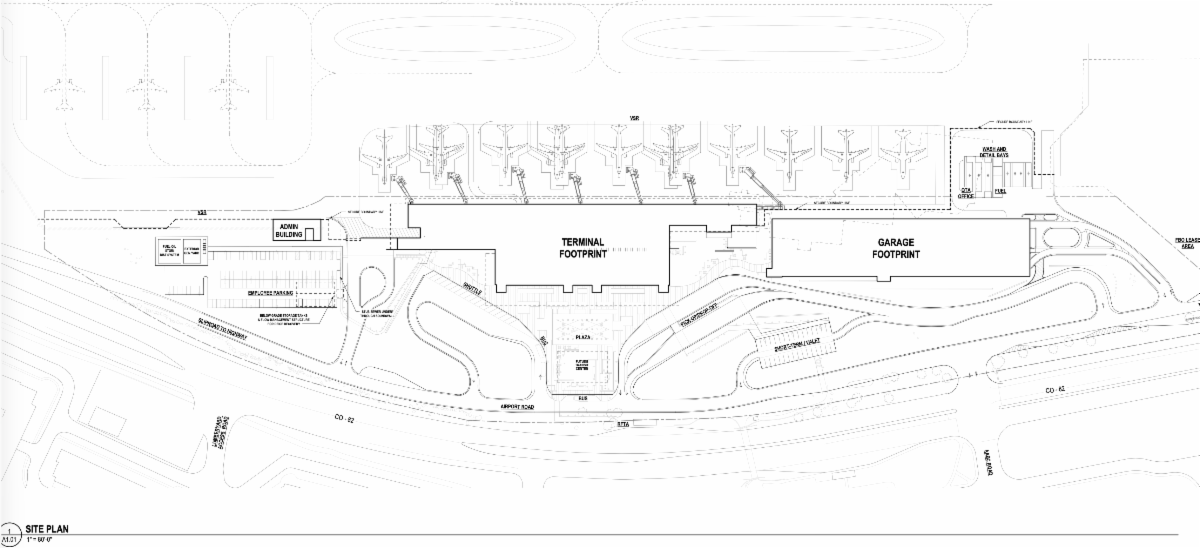
No, this isn’t the seasonal resurfacing that typically shuts ASE down for a couple weeks each spring and fall during the off season. This time, the runway itself is being ripped out, relocated and widened. The terminal will also be rebuilt (opening scheduled for 2029). The shutdown will likely last a year, despite the county’s vague assertion that the closure will “only” be until November. (When was the last time a government project was completed on time?)
Are you ready? For reference, word on the street so far is that The Little Nell, The Gant and half of The Dancing Bear will be shutting down operations for major overhauls while Aspen is “quiet” without its airline passenger guests. Then talk to any architect or contractor and learn how many homeowners plan to use “the quiet year” to work on their houses too. Just think, by spring 2027, the new base development and hotel construction at Lift 1A will be in full swing, The Armory remodel will be underway and The Lumberyard across from the airport will be in its vertical construction phase. It promises to be a frenetic construction scene around here, to say the least. (Let’s hope we still have a bridge!)
The most unsurprising fact is that no one is actually in charge. There is simply zero leadership in Aspen. Sure, the county runs the airport, but they’re pretty squirrelly about reassuring the populace that this isn’t going to be wildly disruptive. Probably because this will be the most disruptive thing to jolt our lives and our economy since, well, the repeal of the Sherman Silver Purchase Act in 1893. No entity is willing to issue an emphatic promise of “only” an 8-month closure. They all know better.
But what about local businesses? Crickets from ACRA, which has revealed itself to be merely a tourism marketing department of the city, with no “chamber of commerce” assistance to local businesses unless you count offering discounted employee ski passes to its members (otherwise none would join). But even their “tourism marketing” skills are sorely lacking when it comes to the airport closure. There’s been nary a peep about what they plan to do about it, if anything, and no community-unifying message to protect our lifeblood industry. Only the pathetic assurance that “the next 12-18 months are critical for providing clarity and coordination.” Ya think? Maybe you ought to provide that clarity and coordination today because the airport closes in 12 months and communicating with the guests who are here in the meantime in hopes they’ll come back makes more than just a little sense.
ACRA did conduct a survey where all of 271 parties responded. A full 43% feel completely or somewhat unprepared for the airport closure. While awareness is high, preparedness is low. One might take that as a not-so-subtle nudge to get cracking.
What are the statistics on how many Aspen visitors fly in each season? You’d think we might want to get an idea of what we’re looking at and what’s at stake. But no. Despite sharing no metrics and pointing to ACRA, Aspen’s car-hater herself, mayor Rachel Richards, hopes vehicle trips will be way up to “offset the loss of those who would normally fly into Aspen.” She hopes? Is hope a strategy? That’s surely A LOT of cars! I wonder where she wants them to park?
C’mon, folks. Food & Wine, ACRA’s marquee event, kicks off the Aspen summer season in just 8 short weeks. How about getting it together with a bold message in time for that so we’re able to reassure this key demographic and repeat customer just how “okay” it will be next year. If it will. Offer compelling pre-paid discounts on 2027 passes and lodging to lock them in. Promote the alternative airports and the affordable, regularly scheduled, non-stop, executive motorcoach transportation that you’ve surely contracted to conveniently and regularly run to and from Aspen throughout the entire shutdown.
That’s the low-hanging fruit. Then adapt that optimistic messaging for the June and Labor Day JAS events, July 4, Theatre Aspen and the Music Festival, not to mention our second homeowners and summer visitors of every stripe. The idea is to reassure these folks with well-considered answers so their returns in 2027 are never in question. To the 37% of survey respondents who have no inclination to promote/discount in response to the closure, you might want to think again. If you build it, they just might come. Hubris, like the law of unintended consequences, is also a frequent visitor to Aspen.
SkiCo would also be wise to pay close attention. Remember what happened when snowboarding wasn’t allowed on Aspen Mountain? When word got out, it morphed into the widely-spread rumor that snowboarding wasn’t allowed ANYWHERE on Aspen’s mountains. Not good. While winter 2025-26 ended with a thud (or whatever a crash on slushy slopes sounds like), 2026-27 booking is currently underway, and next winter is the opportunity to offer your visitors special 2027-28 lodging and lift packages with plain-speak about how it will be worth it to work just a little harder to get here. There is absolutely no guarantee that the airport will be functional during winter 2027-28 despite hope being our best strategy. But the inevitable message that “Aspen is closed” is not your friend. This one is a runaway train. It’s coming. Get on or get hit.
The only apparent “stress” in the community at this stage over the airport closure appears to be coming from our subsidized housing brethren. Many seem to be concerned about attaining their required 1500 annual work hours given the likely local economic impacts. It’s a valid concern. Yes, furloughs could become a reality. APCHA’s response? Instead of pointing out the obvious and UNPRECEDENTED number of well-paying, in-town jobs associated with 2027-28’s massive generational infrastructure and construction projects, the housing authority is actually discussing “suspending” the annual work requirements. God forbid APCHA residents dirty their hands by working local, well-paying construction jobs to meet their obligations to the community (and in so doing, keeping cars off Hwy 82). Instead, without work requirements, those who can afford to will be happily skiing, golfing and biking as though they too are on vacation. As I’ve always said, APCHA has never been about work or filling jobs.
Alternatively, are you planning your “junior year abroad?” If you can’t live without an airport and GJT or EGE won’t cut it, if massive construction isn’t your thing, or if dealing with more vehicle traffic by an order of magnitude kills your Aspen vibe, 2027-28 just might be the unique window of opportunity you’ve always dreamed of. Maybe it’s time to try something new and go elsewhere for the season(s). Update your passport and don’t sleep on calling your realtor to get your place rented if you can. My guess is once others catch on, it will be like rats leaving a sinking ship!
And for those who’ve long and vociferously been pining for Aspen’s bygone eras, specifically The Quiet Years, you just might get your wish. The tourist visit numbers could easily dwindle. No spiking the football, please, while businesses struggle and people’s livelihoods are at risk. This is what you’ve always wanted. Be humble in your ugly victory.
The airport project is long overdue and will ultimately benefit Aspen. But how we face and address its closure will define us as a community for years to come.
April 6 "The only thing worse than being blind
is having sight and no vision."
-- Helen Keller
|
Aspen’s forefathers are rolling over in their graves. The “Preferred Alternative” epitomizes the complete loss of Aspen’s forward thinking, innovative, visionary and decisive leadership. Walter Paepcke’s vision of a think tank for radical ideas brought The Aspen Institute. Hunter S. Thompson’s bold counter culture movement became Freak Power. Aspen is thousands of subsidized housing units ahead of comparable resort communities because early housing pioneers made it happen. Is clinging to a 1998 transit plan really our best thinking? The smartest plan? Or is it just one more byproduct of a bloated city government and recycled mayor, hell-bent on saving an old idea because they lack the intellect, creativity, vision and innovation that once defined Aspen? As predicted, the recent city confab to update us on the evolving plans for the Entrance to Aspen was a check-the-box exercise. (They can now say they sought and received public feedback, regardless of what they do with it.) Despite a good-sized crowd, it was a typical anemic oral presentation accompanied by storyboards and feedback forms, and a strange amount of time talking about bus lanes on Main Street. Queen of the 1998-era Preferred Alternative (1 dedicated traffic lane and 1 bus lane in each direction across the Marolt Open Space) herself, mayor Rachel Richards, was in attendance and appeared quite pleased. There was, however, lots of casual grumbling amid the storyboards about the “bastardization of Marolt,” and some well-founded snickering about renderings of large trees planted in 1.5’ of top soil atop the proposed tunnel(s). In short, there hasn’t been a lot of progress. The pesky problem of trying to hammer a 2026 square peg into a 1998 round hole is getting more and more complicated. Even Jacobs, the contracted engineering firm, is struggling with reconciling potential solutions with what the city (who is now paying its bills) wants the solution to be. At issue, the city wants to utilize an outdated 1998 record of decision (ROD) for the Preferred Alternative because it would be seemingly quicker and cheaper than starting over from scratch with a new Environmental Impact Study (EIS). The problem is, there have been numerous significant developments since 1998 that are currently being ignored. We have consolidated our schools on Maroon Creek Road. We have developed new neighborhoods on West Main Street. The Lumberyard stands to increase our local population by 10%. The airport redevelopment will likely redefine transit into Aspen. Without taking these and countless other new factors into account, the 1998 ROD is likely no longer applicable because so much has changed. Today’s piecemeal process also neglects several significant “asphalt” departures from the 1998 ROD that have never been evaluated including the potential for two tunnels and “slip lanes” that connect Cemetery Lane to the roundabout. All these changes make the 1998 ROD questionably viable and likely dead on arrival. The net result will be yet another colossal waste of time and money by the City when it is forced to start over at the beginning with a new EIS process. Meanwhile, Jacobs has been studying this mess for nearly three years now. They put forward a series of potential improvements that would ease traffic flow – without a new bridge – at a fraction of the cost and that could be implemented TODAY. The City has chosen to ignore this advice. Jacobs has a design for a 3-lane “shifted” replacement (Castle Creek) bridge that would maintain 2 lanes of traffic during construction. The city isn’t interested. We could be two years into the Castle Creek Bridge replacement instead of still conceptualizing the Preferred Alternative and where to put bus lanes on Main Street. Jacobs is unequivocal: the Preferred Alternative will make traffic WORSE for cars and trucks. The City’s inaction reflects their indifference: “Great. That’s the intent.” I know, you’re exhausted by the topic, but since when did old thinking lead to a better infrastructure project? No one can even debate the facts of the Preferred Alternative anymore. Simply put, other significant Hwy 82 corridor improvements can be implemented long before any new bridge can be built. No federal funds are needed so there is no regulatory approval. CDOT could start right away. To be clear, there is no clarity on timing for the Preferred Alternative. The 5-year timespan often mentioned is 2 years for design and 3 years to build. This ignores mitigation, regulatory approval, environmental considerations and funding, which add to the timeline. Furthermore, the Preferred Alternative is not even on CDOT’s 10-year construction schedule. In contrast, replacement of the Caste Creek Bridge (which must be replaced in ANY case), would be significantly quicker since construction is over an existing right-of-way and has no mitigation issues. Whether it’s paralysis from fear of a wildfire evacuation* (which was never supported by a comprehensive evacuation plan) or fatigue (“Just do something. Even if it’s wrong.”), it’s a tough argument that a 1998 plan is still our best option. What we have today is the 80/20 rule at work. We can get 80% of the benefit from Hwy 82 corridor improvements for 20% of the cost. There are several simple but impactful improvements that can be immediately implemented: · S-Curve widening · Channelize westbound lanes at the roundabout · Align Owl Creek Road and Harmony Road intersections with Hwy 82 to reduce a traffic light · Convert the bus lane to HOV + bus · Add slip-lanes at the roundabout But these low-cost, traffic-easing improvements are deliberately being held hostage by the city. They want that straight shot across Marolt and a new bridge, or nothing. See, if they improve traffic without the new bridge, then there’s ZERO case for funding it! So why won’t the city go ahead with the corridor improvements today? “It makes a more compelling funding package to present the plan together,” according to Tyler Christoff, deputy city manager, responsible for major infrastructure and development initiatives. There is so little benefit from the big ticket ($400 million in 2026 dollars) project that they have to bury it within the real traffic improvements! In summary, the Preferred Alternative doesn’t save travel time. Other improvements to Hwy 82 immediately provide far more juice for the squeeze. The ROD needs to go away, and with it, the delusion of the Preferred Alternative. We absolutely do need to address our traffic and congestion issues. This just isn’t it. How about an innovative 21st Century solution to our 2026+ problems? And in the meantime let’s replace the deteriorating Castle Creek Bridge today. Remember - there’s no entrance to Aspen without at least one bridge!
*For those of you who fell for the canard about emergency wildfire evacuation last year, that was just a ruse to get you to vote for the Preferred Alternative. In an actual wildfire, you will not be evacuating westbound out of Aspen straight into prevailing winds, across any bridge. You won’t. You think 1000 cars at 5pm is gridlock? Consider 10-20,000. It’s not gonna happen. The City says, “A full wildfire evacuation out of town could take 12+ hours. A ‘quick’ evacuation is not a reality.” Remember Lahaina? Plans have evolved toward “property hardening” and directives to “shelter in place.” |
|
|

|
In 2024, public polling revealed that 86.3% want improved traffic and transit times. Here is a "time savings" chart courtesy of Civic Aspen. |
|
|
|
And FYI re the ongoing ROD "evaluation." It's a collaborative process between the City, the state (CDOT) and the feds (FHWA). The decision is two-pronged. If CDOT feels the City's changes to the ROD are out of line for a state road, they can kill it. (The City is currently trying desperately to keep CDOT on board.) But the feds are the ultimate decision-makers under NEPA and all federal statutes (think: environmental). The ROD is technically a federally-generated document because federal money is involved. The feds can tell the City to start over for a variety of reasons (age of the ROD, changes in conditions, purpose and need, new configurations never evaluated or already rejected, etc.). When you consider timing and funding questions and considerations, we are easily looking at a decade from now. See why it's a really bad bet to assume the Castle Creek Bridge will last until something new can be built? |
March 23 "The public is the only critic whose opinion
is worth anything at all."
-- Mark Twain
PUBLIC OPEN HOUSE - THIS THURSDAY - MARCH 26
Heads up! The City of Aspen is hosting a drop-in open house to update the public on the status of the Entrance to Aspen project. As is typical, they reference a "re-evaluation" but don't say what's being re-evaluated. And then they tease "design modifications" with no detail. It's all very suspect, but it would seem that things might be evolving.
The only re-evaluation I can imagine is that the city's foolish decision last year to try to make all of its 2026+ wishes fit into a 1998 approval without triggering a new environmental review process is not looking good. (A new EIS is likely inevitable and will add YEARS to the process.) I also have it on good authority that the feds are already sending warning signals about funding for this project.
I know, I know, the city holds these events just to check a box and say they've done "public outreach" when they have no intention of taking feedback into account, but we haven't heard anything since last year's vote that approved dedicated bus lanes across the Marolt Open Space. The "project team" will be making a presentation from 5-6 PM so maybe there will be some new intel and visuals on design refinements?
This may very well be your only opportunity to provide input on this issue!
The great irony is that of course - after all the "public meeting space" we are forced to build and fund throughout town - this event will be held during rush hour from 4:00-6:30 PM at Colorado Mountain College (255 Sage Way) out by the airport. Do you think they might be trying to keep attendance low?
There are a couple of key things to note about this meeting:
This indicates that AFTER 30 YEARS, "congestion" has finally been acknowledged as a problem and might possibly be addressed. Imagine that.
Sadly, what's still missing is innovation. The "Preferred Alternative" is hopelessly out of date. We have a critical situation with the deteriorating Castle Creek Bridge that MUST be replaced in any case. According to Jacobs Engineering, a new bridge can be built to replace the existing one WITHOUT SHUTTING DOWN TRAFFIC. What are we waiting for?
(My prediction is that weight limits for the bridge will be implemented this summer, just in time for the massive construction excavation at the Lift 1A site.)
Keep in mind: There is no Entrance to Aspen without at least ONE functional bridge.
PLEASE make your voice heard.
And if you can't make it, HERE is the unwieldy City website on the Entrance. Look for the specific field for your comments. Please make your opinions known. Be factual and unequivocal.
March 9 "Sometimes the point isn't to make people believe a lie. It's to make the people fear the liar."
-- Anne Applebaum
THANK YOU
I was heartened and humbled by your responses to my "return" Ant last month (The Aspen Zeitgeist). Let's do this. But moving forward, heads up, there just might be some homework. Watching from the sidelines is clearly not a winning strategy, and we're about as close to the wheels coming off as we've ever been.
Upon receiving my last Ant on February 6, the Aspen Daily News contacted me about contributing a guest column to follow up on the lack of coordination between the city and county on the massive infrastructure projects currently in the pipeline. I was happy to submit THIS column, which ran on Sunday, February 15. I am grateful to have had this opportunity.
Ever hopeful to return to print, I recently sent them the following, unsolicited. They weren't interested, but I won't give up. It's the promised Part 2 to "The Aspen Zeitgeist," specifically on subsidized housing.
As always, I love hearing your feedback. And if you have friends, neighbors or colleagues who'd enjoy reading The Red Ant, please feel free to forward this email or send them my way.
ASPEN'S HOUSING LIES
This community is lying to itself about housing.
Time and again, we tell ourselves and each other that we can’t “build our way out” of our housing challenges, yet we continue down a never-ending path of building for desire and not actual need. Who doesn’t want to live in Aspen affordably?
In the city, we now allow subsidized housing development in all zone districts with mass, scale and parking exemptions, the county says it’s okay to build subsidized housing in rural areas, and any employer that can afford to is clamoring to build its own inventory, all while we refuse to examine what we already have and optimize its use for the betterment of the community that paid for it. There is complete disregard for accurate and transparent metrics in favor of political expediency and for fear of hurting people’s feelings.
Recently, when former mayor John Bennett spoke out in favor of the massive subsidized employee / visiting lecturer housing proposed by The Aspen Institute, Aspen Music Festival and School and Aspen Physics Institute for their shared campus in the West End, one major lie stood out. Bennett confidently stated that all this new housing will remove cars from Hwy 82. Really, John? And that’s based on what exactly? A gut feeling? Isn’t that what they told us about Burlingame? How’d that relieve traffic? And notably, “cars off 82” is also a primary justification for the soon-to-be-built 277-unit, all-rental, half-billion dollar Lumberyard, home to 435 cars.
Here are some very inconvenient truths about housing in Aspen, and note: I do not call it a “crisis.” It’s a disaster for sure, but of our own making.
· Willful ignorance. There are no metrics on what’s changed or improved with the housing we’ve built. No one is tracking which businesses are unable to hire for lack of housing and for which jobs. We can only guess-timate our total number of jobs and workforce size. In other words, everyone seems to blindly accept that we have a housing “crisis” but no one asks for it to be defined or quantified.
· No prioritization. Simply put, there are some jobs that are more critical to the functioning of our community than others. Sorry, realtors, I’m talking doctors, nurses, first responders, teachers, resort/hospitality/restaurant workers, transportation providers, road crews and utility workers. We need to prioritize housing our essential workforce in units subsidized by the community. The only reason we’re subsidizing other “workers” is so as not to hurt their feelings. It’s not personal. Public housing should address a public need.
· Zero transparency. We barely know our housing inventory. And only APCHA staff knows who’s in it, if and where they work, and how many empty bedrooms there are. APCHA’s insistence on hiding the facts from the public has become widely accepted. This dereliction of management by our electeds only serves to further the false narrative of needing more.
· Growth impacts. While our local governments regulate and tax all private sector development, insisting on punitive mitigation for this unwanted “growth,” they perpetuate the intellectually dishonest characterization of subsidized housing development as “impact mitigation,” not growth. Tell me again how the 24/7/365 community impacts of a 265,000 sf, 277-unit housing development are non-existent while the impact of re-developing an existing private home warrants mitigation fees for an arbitrary number of employees generated (cleaners, landscapers, maintenance) based solely on the square footage.
· Double standards. The city and county have their own employee housing units. And they encourage private employers who can to build their own inventory. Yet APCHA does not allow other local employers to participate in the housing lottery, illustrating how little we really care about optimizing our inventory and long-term unit maintenance. (No employer-owner would tolerate empty bedrooms or allow their employees to trash a unit without repercussions.)
· The failure of APCHA ownership. There is no incentive for owners to maintain their APCHA units. Demand is so high that squalor sells. A new publicly-funded repair grant program shifts maintenance from owners back to the community that subsidized the units in the first place. Increasingly high HOA dues are curbing qualified applications and enabling singles to purchase 3-bedroom units – hardly inventory optimization. An aging APCHA population and a growing number of retirees creates increasingly more empty bedrooms, and there is zero requirement or incentive to right-size.
· No central waitlist for rentals. Anyone seeking a subsidized rental must get on a waitlist at every complex. Nothing governs who gets chosen other than being APCHA-qualified, making it nearly impossible to gauge future availability and wait times, and creates a “wild west” environment of bribes and favors.
· Cultural “upward drift.” The game is to get into APCHA housing and then be set for life. It only matters what you make and what you’re worth on the day you buy. After that, you just have to work 1500 hours a year in the county. Once in, most leave the essential workforce for higher paying opportunities, oftentimes for remote employers.
· APCHA ownership units actually keep housing from the essential workforce. When 80% of our jobs pay Category 1 and 2 salaries, and less than 20% of our housing inventory is available to this group, we are instead subsidizing a middle class whose demand for community services is 24/7/365 (far greater than our visitors’), creating work rather than providing it.
· No goal, no definition of success. Today, seventy percent of our year-round population lives in subsidized housing. Since most new housing is subsidized housing, is this still “mitigation” or is it now the primary source of local population growth? How much is enough?
If the question “Who wants to live in Aspen affordably?” continues to drive the debate, we can never attain the infinite number of subsidized housing units “needed” to meet such “demand.”
The entire subsidized housing conversation in Aspen is a lie. As the old adage goes, to tell one lie, a thousand lies are needed. I just gave you ten.
March 9 "Most of the social history of the Western world, over the past three decades, has been a history of replacing what worked with what sounded good." -- Thomas Sowell
Oh, hi. It’s been a minute. (Closer to a year.) The Aspen muni elections in March 2025 were the straw that broke this camel’s back. Aspen dusted off career politician Rachel Richards and made her mayor once again (she needed a job to keep her housing) and re-elected John Doyle, he of alarming anti-Semitic views. I was disgusted and decided to take a step back for a while and just watch.
During this hiatus, one thing became abundantly clear: we have a horrific news void. It’s hard to care when you’re unaware. Read about a public matter in the papers one day and never read about it again, unless it’s to parrot city talking points or casually mention another higher cost amount, and there’s never any critical analysis. Sadly, there’s no good way to stay abreast of Aspen public policy. There are too many balls in the air, by design, creating too many issues for a citizen to track. Overlay an indifferent electorate that gives minimal public pushback on the current outrageous and costly policies and programs coming from our local governments and, voila, you get what you pay for: bureaucracies running amok.
I miss writing The Red Ant, but after 18 years of trying tirelessly to affect local matters, the results at the polls last March were so disheartening that I questioned my appetite to continue. I still care deeply, but do you? While you think about that, I thought I’d fill you in on what’s been going on. Buckle up.
Jobs and Growth
According to the 2024 Pitco Economic Report, the county has more jobs (17,400) than housing units (13,350) and labor force (11,236) so we obviously have to import labor unless we want to build THOUSANDS of housing units. These simple facts are notable in a local environment of -4.1% population growth, low job growth and essentially zero free market housing unit growth. Why on earth wouldn’t we focus on transportation solutions for importing labor and maximizing the maintenance and efficiency of the already huge workforce housing stock we already have, vs solely trying in vain to build an infinite amount “more”?
With regard to growth, Aspen is effectively at build-out, therefore the 277-unit Lumberyard subsidized housing project across from the airport was annexed into Aspen, primarily to harness votes, just like at Burlingame. Astonishingly, despite our long-held community no-growth values, THIS growth (and more just like it) is apparently now ok, never mind The Lumberyard alone adds 10% to our local population. There has been no consideration of the impacts of 600 new residents on the roads, the schools and the hospital. It seems our electeds changed our values without asking! Pitkin County officially spells this out in its 2026 Comprehensive Plan, stating “The growth we do want as a community, that meets our community values, is more affordable and middle income housing. We want to grow the community that will participate in our community…” As if those who pay for such things don’t “participate”???
At a joint council – BOCC meeting in September, clearly surprised by the LY population growth figure and the very real associated impacts on local services, commissioner Kelly McNicholas-Kury sheepishly asked, “How do we study that?” Yes, she asked that, this far into a what will be a half billion dollar+ expenditure. It’s fun playing developer until you have to reckon with the unintended consequences of actual growth.
Alas, they’ve finally said the quiet part out loud: subsidized housing growth is good. It “builds community,” never mind the 24/7/365 impacts by these folks who property tax-wise do not pay their fair share. Those impacts apparently don’t count. It’s the free market growth that’s the problem despite there being next to none. Again, if you live in free market housing, you’re really not part of the community either. (You just pay for it.)
The county now factors “intensity” into its calculus in addition to density when evaluating larger free market homes. Stated as settled fact, “The intensity data analysis establishes a correlation between the square footage associated with large residential homes and the associated impacts to economic, transportation and climate intensity. It also highlights the need to recognize and address the fact that large homes are not acting like conventional homes but more like commercial hubs with workforce-and-vehicle-trip-intensive micro-economies.” Yes, class warfare has transcended local attitudes and is now officially part of local governance.
Incidentally, speaking of governance, the second largest job growth sector in the county is in Public Administration. The city and county currently have 385 and 453 employees, respectively. Yes, you read that right, well over 800 local government employees! I suppose it takes a village to spend 2026 budgets of $296.2 million (city) and $312 million (county)!
The Lumberyard
Construction of the 277-unit Lumberyard subsidized housing project has gotten underway. Today’s cost estimates are at $400 million ($1.4 million/unit), but change orders have already started coming in despite Infrastructure Phase 0 starting in April. In the city’s 2026 strategic plan, to my great surprise (horror?), the number of units remains a moving target (“280-300”) implying that the design is still not yet final. Another example of the city of Aspen building the plane while flying it! Targeted completion is June 2029. With “the city as developer,” what could possibly go wrong?
Here’s what. Just last week council was informed by its very own “affordable housing development manager” who serves as the “owner’s rep” on the project that – oops – they overlooked the need to tie the electrical grid at The Lumberyard into city electrical infrastructure. It’s apparently “an adventure” right now as the city navigates numerous complicated easements at the AABC to make this happen. But don’t worry, they say they’re “pretty positive” and “think they have a pathway,” plus there are lots of “ideas” being kicked around.
Council’s reaction was predictable. Bill Guth was rightly horrified at the monumental oversight at this late stage, questioning how we got so far along without considering a power source. Rachel made excuses for city staff’s abject buffoonery, and John Doyle reliably pivoted to “solar,” earnestly believing this could be a viable substitute.
The Lumberyard is also on track to add yet another stoplight precisely at the chokepoint of Highway 82, just east of the airport. The city still maintains that not many cars will be making eastbound left turns from The LY into town, despite there being on-site parking for 435 vehicles. If that’s the case then why not force them to turn right and make a U-turn at the airport light? And at a certain point, wouldn’t an underpass for eastbound Lumberyard traffic make the most sense, like at the Maroon Creek Club?
If there’s any good news at The Lumberyard it’s that it will be an all-rental complex, with compliance monitored annually through lease renewals, maintenance baked into rent costs, and an end to the “set-for-life” scenarios for those in APCHA ownership housing.
On a side note, I have long wondered why we don’t require subsidized housing residents to live by and exemplify our “save the plant” community ideals by eschewing cars and relying on public transit. For the benefit of living in a $1.4+ million subsidized apartment, it’s really not a big ask and would be a solid step toward doing something in return for the community’s largesse. Snowmass Village is currently considering this for its pending housing project.
Entrance to Aspen and The Airport
The Airport replacement project is officially slated to begin in April 2027. This undertaking, currently estimated at $518 million, is a much needed infrastructure upgrade that also presents a generational opportunity to solve the “entrance to Aspen” conundrum. With reconfigured runways, a new terminal and an improved facility and property layout, this is our chance to create a 21st century transit center that revolutionizes “the last mile” into Aspen proper and establishes an “entrance to Aspen” that solves our worst problems and creates something we can all be proud of.
It’s currently chaos from the Hwy 82/Brush Creek intersection inward. Traffic is horrendous. The county is shopping airport terminal designs while the city focuses on developing The Lumberyard across the street and dithering about “the entrance” which is nothing short of a dysfunctional community embarrassment. Meanwhile, there are really cool ideas circulating elsewhere about aerial trams and novel innovations that could address “the last mile.” The most recent airport design provides for parking for over 900 cars. Why aren’t we looking at this holistically and integrating it all? Imagine a transportation hub at the airport that offers convenient, reliable, multimodal solutions into town for airline passengers, commuters, Lumberyard residents and those living in the 300 units at the AABC?
Apparently this is not at all a priority, yet alone even a consideration. County commissioner Francie Jacober, clearly caught in the deep myopia that pervades our elected bodies, said of collaboration between the city and the county on the airport, the entrance, The Lumberyard and the last mile, “The county is looking at the airport thing right now, so for us to take on another huge design and research project would be pretty difficult. The city is looking at the entrance, so there are two obstacles right now in terms of making progress with another huge infrastructure project.”
How can our electeds ignore the need to address these projects TOGETHER? Sadly, despite $1 billion in concurrent, adjacent projects, the city and county have zero coordinated planning or shared vision, just “silo” mentalities. Such ignorance will be the cause of a tragic missed generational opportunity. And likely far worsened transportation gridlock where it occurs today. Welcome to Aspen.
The Straight Shot, Castle Creek Bridge and Traffic
In March 2025, after a contentious battle, the electorate voted to give CDOT free reign to realign Hwy 82 across any part of the Marolt-Thomas Open Space of their choosing to create a more direct route into Aspen and bypass the S-curves. This, despite a 28-year-old record of decision (1998 ROD) documenting ad nauseum that this new alignment is merely a mass transit solution that will not improve traffic or congestion.
The “preferred alternative” is an asphalt solution to a 21st century problem that will still feature a single lane for cars in each direction (at the same or slower speeds), dedicated bus lanes, a new stoplight at 7th Street and a left-turn only at Cemetery Lane (head east into town over the Castle Creek Bridge and then turn right at the new 7th Street stoplight to access westbound Hwy 82).
A year later and nothing has changed, nor is it likely to progress for years to come. Why? The city is nowhere near getting CDOT funding; the project doesn’t appear anywhere in CDOT’s 10-year funding queue. Instead, council has directed city staff to re-evaluate the 1998 Environmental Impact Statement (EIS), pretending there have been no major changes to the city’s traffic patterns during that time. It’s an attempt to side-step a costlier new EIS that would take into account the tectonic changes of entire neighborhoods that have sprung up in the past 30 years, the revamped traffic patterns from all points of the roundabout, as well as the imminent impacts of the new airport terminal and Lumberyard now in the pipeline.
Meanwhile, the Castle Creek Bridge that was built in 1961 is precarious. It was rated “fair” by CDOT in 2024. If the bridge falls below a “fair” rating, CDOT could place weight limits on the bridge or condemn it entirely. Council fiddles while the bridge fails. There is no contingency plan. They decline offers to bring in cutting edge bridge experts who have pioneered carbon fiber construction solutions that happen in days, not months. Fixated on the straight shot pipe dream, Rachel ignores the march of time, and technology that is bringing cheaper, faster and greener mass transit solutions. Yes, technology has finally caught up with Toni Kronberg and urban “rope tow” gondola-like systems that are being implemented around the globe. While Rachel clings to her outdated, 1998-era bus-centered vision, RFTA officials protest that they are already operating at full capacity and have no plans to increase it.
Always remember, it was Torre, Ward Hauenstein and John Doyle who spiked a motion in 2024 to rebuild the bridge (it has to be replaced in any case, on the city’s dime). Why on earth are we not replacing the bridge today, optimally with an alternating lane, while the lengthy ROD/EIS process plays out?
Aspen’s 10.35% Sales Tax
As of 2026, aside from Winter Park (11.2%), we officially have the highest sales tax rate (10.35%) in the state of Colorado. Here’s the breakdown:
Colorado state sales tax: 2.90%
Pitkin County sales tax: 3.60%
City of Aspen local tax: 2.70%
Aspen Fire Protection District: 0.50%
Confluence Early Childhood District: 0.25%
Roaring Fork Rural Transpo Authority: 0.40%
Aspen loves to be at the top of every list. Congratulations, geniuses.
Childcare Tax
You were fooled. 7A (a 25 cent sales tax on every $100 purchase) passed locally last fall to create a regional childcare tax district because we were told that our childcare capacity only accommodates 44% of kids in the region who need it. That could be true – in the region. But a November 2025 study clarified the local stats. Turns out that Pitkin County “likely” has a shortage of child care slots for infants and toddlers, but childcare for preschoolers is sufficient. Furthermore, the study concludes that “creating new preschool slots may threaten the sustainability of existing providers.” In addition, the county’s young child population is projected to shrink through 2029. The regional needs are likely far different, echoed in the study’s revelation that a full quarter of those who live in Garfield or Eagle Counties but commute to Pitkin County for work would prefer a Pitkin County childcare provider. Of course they would, especially if we subsidize it.
So here we are, subsidizing other counties’ populations and childcare preferences. Good news is that council just punted a $15 million (2022 estimate) childcare facility at Burlingame because of the “potential to harm the existing childcare infrastructure.” It could still rear its ugly head in the future...
Short Term Rental Regulations
There are currently 387 STR permits issued in Aspen that enable owners to rent out their properties for less than 30 days at a time. Permits range from $148-$394/year. These are distinctly punitive and have become yet another revenue stream primarily dedicated to vague “community affordable housing efforts.”
Check out the taxes. It’s all designed to pinch the greedy homeowner but anyone with a brain knows such costs get simply passed on to the renter. Screw the tourists, right?
Traditional Lodge: 2% (total with sales tax = 12.35%)
STR (owner-occupied): 5% (total with sales tax and 2% lodging tax = 17.35%)
STR/2nd Homeowner: 10% (total with sales tax and 2% lodging tax = 22.35%)
Yet an inane debate rages on. The fact is, people have rented their Aspen condos to tourists for generations, long before Airbnb. A large, uninformed yet vocal group ignores this and honestly believes that if we outlaw all STRs, condos in the downtown core will magically become rentals for local workers again. But seriously, why would owners rent at “affordable” prices when property values and costs have quadrupled? It’s not STRs that took away rental condos from locals, the market went up. Condos once purchased for $500K are now worth $2M+. Do the math. It makes zero sense for owners to rent these out for $2000 a month - to anyone.
Taster’s/Yogi’s
Besides playing developer, city hall loves to monkey in commercial real estate and restaurant oversight. There’s a long track record of failure, yet they continue, most recently trying to find a new tenant for the city-owned restaurant space across from Rio Grande Park, intended as an affordable restaurant that offers below-market rent. The finalists for the deeply subsidized space are in, and they represent popular entities in the valley. There’s also a high profile PR campaign by one applicant, the 520 Grill, a local’s favorite currently in a free market location on Cooper Street.
All the letter-writing and hullabaloo made me take a closer look. It turns out that many of 520 Grill’s current menu prices will actually INCREASE if chosen for the subsidized space! It’s in the RFP in black and white. The point of the whole exercise is to be able to offer the community affordable options. Council tends to decide such issues based on who’s a “good guy,” so maybe this won’t matter. But shouldn’t prices technically go down when the rent does? Just think, if 520 Grill wins, we’ll be subsidizing both the rent AND the owner.
Don’t get me wrong - everyone loves 520 Grill. Food’s great. But just like city council, they’ve missed the plot. Just keep prices the same and profits will increase. Duh. Here’s one more glaring example of why it’s simply bad public policy for city incompetents to be picking winners and losers in Aspen’s competitive restaurant landscape.
The Armory
Speaking of subsidized restaurants, look for a 5-kitchen food hall, a bar, billiards and a teenage hangout lounge in the soon-to-be-remodeled Armory. Add to that "flex space" for meetings, banquets, a market and a visitors center and it’ll practically be like the carnival has come to town. All for today’s estimated cost of $53.7 million.
But don’t you remember, back in 2018 when we voted on our preference for a new city hall? Championed by yours truly as well as longtime locals Bill Stirling and Howie Mallory, the option to purchase 517 E. Hopkins from developer Mark Hunt as the future location for new city offices (across the street) to supplement the existing city hall in the Armory was shot down 57%-43% at the polls in favor of today’s new Taj Mahal City Hall. Hunt’s deal was a committed contract to deliver a redeveloped building at the 517 E. Hopkins location, connected by an underground tunnel to the Armory, for a fixed $45 million. He also offered to remodel the Armory for just $9 million more. It was too good for the bureaucrats to stomach.
Fueled by the city’s own campaign reflecting its vitriol toward a developer (former city manager and Red Ant foil Steve Barwick actually said, we “don’t want to put money in local developer Mark Hunt’s pocket”), voters chose to accept the city’s farcical estimate of $42-52 million not including the land cost, to build the Taj, which came in costing closer to $100 million. (The terrible location is where a large in-town subsidized housing complex belongs.) Today we’re looking at spending $53.7 million (and counting) just to remodel the Armory. Do you actually think the city’s cost estimate will hold?
Just like the hideous, ill-functioning, ghost town office space that is today’s Taj, the Armory and its plans to be all things to all people (hardly the “community gathering place” that many sought) will be another grossly over-priced disaster for Aspen. Will we ever learn?
Meadows/Institute/Physics Housing
The latest trend is that major employers have finally given up on APCHA and are developing housing to meet their proprietary needs. The latest is a proposal by the Aspen Institute, Aspen Music Festival and School and Aspen Center for Physics to develop 60 units for employees, students and guests on their shared campus in Aspen’s historic West End.
Despite concerns about the STR-like nature of some of the units and overwhelming pushback from the neighborhood over the impacts of an already untenable parking situation, the submission moves along.
It is noteworthy how this proposal stands to be dramatically “under-parked” with P&Z advocating for deed restrictions that don’t allow cars at certain proposed buildings, which will only add to the parking strife in Aspen’s toniest neighborhood. Contrast this to the deliberately “over-parked” Lumberyard that is providing 453 parking spots for 277 subsidized units. Double standard much? Mayor Rachel seems to think that “at the end of the day, we do have to have a little give from the (West End) neighborhood.” Really?
This is not a fait accompli. Frankly, it needs a lot more work.
Housing Shortage?
Do we really have one? Are there legitimately businesses in town today that cannot hire for lack of housing? For which jobs specifically? Glenwood Springs has built over 700 units in the past 5 years. At Willits, there are 196 new apartments at the Tree Farm Lofts. Next to Carbondale City Market are 224 new apartments. Near Target in Glenwood are 400 new apartments. All of these are on the RFTA transportation corridor. From a cost perspective, the Carbondale apartments were $265K per vs. $1.4M (estimated) at the Lumberyard. And remember, we have no idea which workers are currently being housed in our APCHA inventory. In other words, we have yet to identify what problem we’re trying to solve - other than building “more.”
Mid valley communities have historically resisted building worker housing for up valley employers but now that many local jobs are moving to the mid valley, they can’t avoid it. However, this movement of jobs out of the upper valley directly reduces the pressure on workforce housing in Aspen proper, and perhaps even eliminates it if we manage our existing inventory properly.
To ignore the impacts of this significant increase in housing units in the greater valley on what is purported to be a “housing crisis” in Aspen is intellectually dishonest. Can you see now why no one wants to commission real data or share what does exist? It destroys the narrative of infinitely “needing more.”
This obfuscation and nonsense continue despite the our community guiding document, the 2012 Aspen Area Community Plan (AACP), clearly stating that “we cannot build our way out of the housing problem.”
Do we really OWE housing to everyone who wants to live in Aspen affordably?
Retirees in APCHA Housing
At one point, The Silver Tsunami was a notion. Then it was coming. There is no doubt it’s arrived, and we’re surely taking on water. But don’t expect APCHA to reveal this data. The numbers are perhaps Aspen’s most closely guarded secret. And I’ve yet to hear a local reporter ever ask for them. The surely staggering retirees-in-APCHA-housing numbers are deep within APCHA’s clandestine HOMETREK database and in assistant APCHA director Cindy Christensen’s head.
Next to no data is publicly available anywhere. The 2012 AACP acknowledged that we “are on the brink of a rising retiree demographic,” citing 310 retirees in APCHA housing in 2012 with a forecast of 800 by 2021. Notably, no substantive “retirement” strategy has been discussed in the 14 years since. Another loose datapoint from 2023 contends that 33% of APCHA unit owners are 63+. Anyone see the troubling direction we’re headed?
Merely discussing the mysterious “retiree numbers” is grounds for harsh criticism, as though knowing our reality is somehow “anti-retiree.” Sorry, knowledge is power, and when we’re doling out $1.4M in public funds per unit for new subsidized housing units with an undefined end goal, factoring in the growing number of units occupied by non-workers must become part of the equation.
I’ll stop … for now
I could go on. And I might. I barely touched on APCHA and that list is so long it simply warrants its own issue. But hopefully this brought you somewhat up to speed. I know, it’s beyond depressing. All of this should read as a cautionary tale. There’s a very fine line between being visionary and being a virtue signaling moron.
The Taj Mahal City Hall and its emphasis on a “one roof” customer service solution seemed to our naïve electeds like the right thing to build (“a 50-year solution”) when in reality there was no vision at all. (Imagine ignoring the work-from-home revolution?) Today the Taj is a huge community stain, symbolic of our bloated bureaucracy with its poor design and reckless execution that notably killed any hope for a town-to-river connection by cutting off Rio Grande Park, and fittingly exists as an empty tomb during most business hours. The airport and straight shot are poised to similarly follow in its footsteps. It’s undeniably tragic to screw up one generational opportunity after the next because of inept elected officials.
There is a good reason I always push to elect well-educated candidates and those with real world work experience. Without it, we get emotional decisionmakers who see every issue in a vacuum. It’s hard to imagine someday electing a majority that seeks enough information to envision and comprehend the larger picture, yet alone the cumulative impacts on our (diminishing) small town character. Don’t take my word for it - just look at what’s happening today.
Please let me know what you think. Do you want to know more? Do you have a friend who’d enjoy reading? I have a lot to say. Question is, do you want to hear it?
March 19 Bad officials are elected by good citizens
who do not vote."
-- George Jean Nathan
THE RUN-OFF ELECTION
I have very little to say about the April 1 run-off election to fill two city council seats. There are 4 candidates still in the hunt: Emily Kolbe, Christine Benedetti, incumbent John Doyle and term-limited mayor (and before that, councilman) Torre. Whatever you do, DO NOT vote for John or Torre.
"BULLET VOTE" FOR EMILY KOLBE
This means vote ONLY for Emily Kolbe, despite being able to vote for two.
The "bullet vote" theory is this: picture a foot race. Unlike a 100 meter sprint that has the same starting and finish lines, where the fastest across wins, this race is determined by who gets the farthest in a set period given the same start. Think of votes as steps. We NEED Emily on council with Bill and Sam. The best way to get her there is to give her a "step" (vote) while not giving any of her competitors one. Please do not give that other step/vote away.
TURN YOUR BALLOT IN TODAY
Your ballot is already in your mailbox, if not on your desk or kitchen table. TURN IT IN TODAY.
This is a simple and quick vote, and for those of us who spend Election Day and those leading up to it "chasing ballots," please make it easier on everyone and just drop your ballot off at the box in front of CITY HALL today. Check this off your list and be counted.